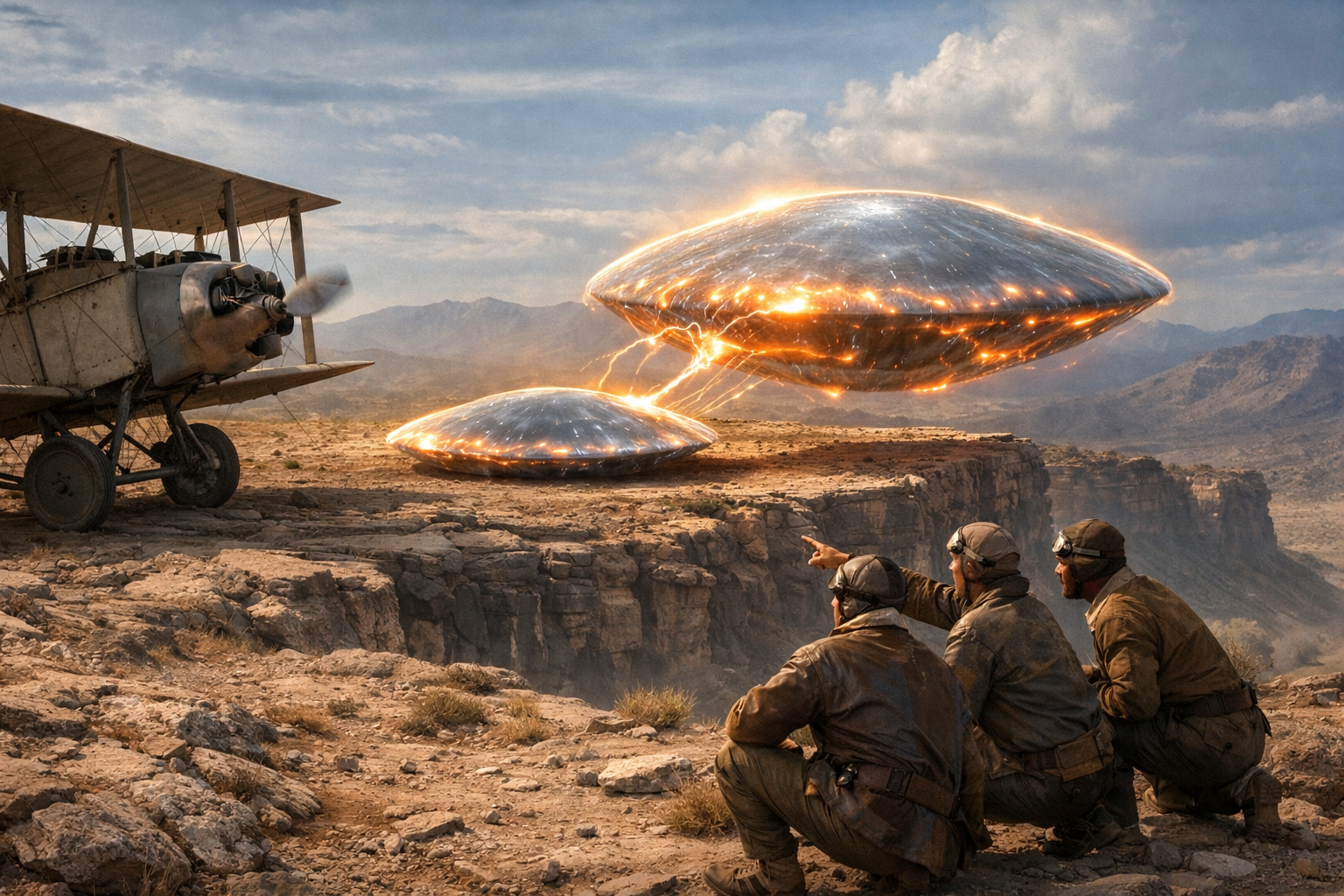
Don Wood Jr., a pilot and aviation enthusiast, reported one of the earliest and most unusual pre-Kenneth Arnold UFO-like encounters on a date in 1925 (exact day and month not specified in accounts, but the sighting was first published decades later). While flying old Curtiss JN-4 “Jenny” biplanes (OX5 engines) with three friends over the Nevada desert, the group landed on Flat Mesa near Battle Mountain, a flat-topped area roughly 5,000 square feet surrounded by steep cliffs that made it difficult to access except by air.
Shortly after landing in the afternoon, the men observed a strange object descend from the sky and skid to a stop about 30 feet away. Wood described it as a round, flat, disc-shaped entity approximately 8 feet in diameter, metallic in appearance but behaving like a living organism rather than a mechanical craft. A larger similar disc then appeared, approaching the smaller one. The two objects interacted in a way that Wood could not determine: whether the larger was assisting, attacking, or attempting to consume the smaller one. They glowed brightly before departing, with the encounter lasting about 20 minutes. Wood emphasized the creatures’ biological nature, noting they moved with organic fluidity rather than rigid machinery, and he believed this sighting explained many UFO reports as misidentified living atmospheric entities rather than extraterrestrial vehicles.
The incident remained private for over three decades. Wood shared it anonymously in a letter published in the October 1959 issue of Flying Saucers magazine (edited by Ray Palmer), offering to provide a signed affidavit if needed. He claimed the experience shook him enough to stay silent until then. The account gained wider circulation through Trevor James Constable’s 1976 book The Cosmic Pulse of Life, where it was presented as evidence of “critters” or living organisms inhabiting the upper atmosphere, existing in infrared or ultraviolet spectra invisible to normal human vision but occasionally visible in certain conditions or polarities.
Constable, along with Dr. James Woods, linked Wood’s sighting to their own research into atmospheric life forms photographed using infrared techniques. They argued these “gargantuan gliders” or “giant space clams” were biological entities that could account for many disc-shaped UFO reports, especially those involving glowing, jellyfish-like or discoidal forms. Wood’s description of metallic sheen combined with organic movement fit this theory, portraying the objects as part of an aerial ecosystem rather than spacecraft.
Skeptics view the story as a tall tale or misidentification, possibly a mirage, atmospheric phenomenon, or exaggerated memory of birds or debris. The 34-year delay in reporting and lack of corroborating witnesses or physical evidence weaken its credibility. No official records, photos, or independent confirmations exist, and the account’s publication in a fringe magazine raises questions about embellishment. Modern interpretations sometimes reframe it as a cryptid or living UFO encounter, appearing in blogs, podcasts like Monsters Above Us, and cryptid wikis under names like “Gliders” or “Giant Space Clam.”
The sighting’s location in the remote Nevada desert near Battle Mountain adds to its mystique, an area with sparse population and vast open skies conducive to unusual observations. Wood’s insistence on its reality and his willingness to swear an affidavit lend a measure of sincerity, but without further documentation, it remains an intriguing early 20th-century anomaly in UFO and cryptid lore.