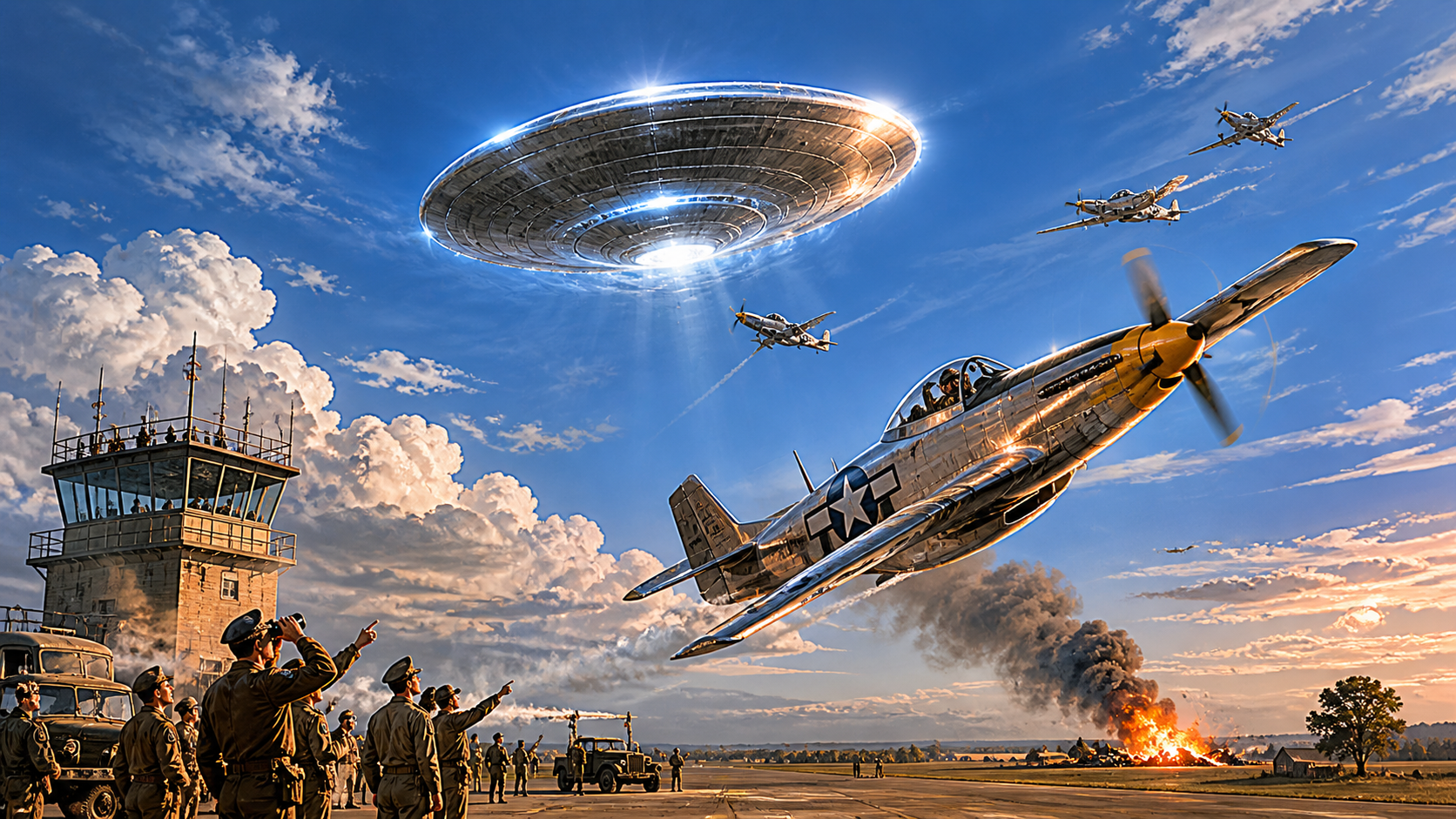
On January 7, 1948, Captain Thomas F. Mantell Jr., a 25-year-old experienced pilot and flight leader with the Kentucky Air National Guard, died in a tragic crash while pursuing a mysterious object near Godman Army Airfield at Fort Knox, Kentucky. This incident, one of the earliest and most publicized UFO cases in U.S. history, became a cornerstone of early UFO lore and remains controversial to this day.
That afternoon, multiple witnesses at Godman Airfield, including the base commander, Colonel Guy F. Hix, reported seeing a large, circular, metallic object hovering in the sky. It appeared bright white and seemed to be moving slowly. When the tower asked for identification, no one could explain what it was. Captain Mantell, who was already airborne leading a formation of four P-51 Mustang fighters on a training flight, was diverted to investigate the object.
Mantell climbed rapidly toward the unidentified object, radioing that it was “metallic” and “tremendous in size.” He reported it was above him and moving at half his speed. As he continued his pursuit, climbing to over 20,000 feet, his last transmission stated he was going to 25,000 feet and would not stop until he identified it. Shortly afterward, radio contact was lost. Witnesses on the ground saw Mantell’s plane spiral out of control and crash in a fiery explosion near Franklin, Kentucky. He was killed instantly.
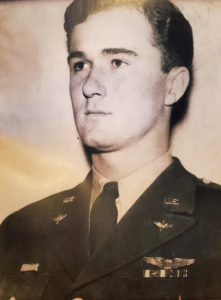
The official U.S. Air Force explanation evolved over time. Initially, Project Sign (the predecessor to Project Blue Book) suggested Mantell had been chasing the planet Venus, which was bright that day. Later, they concluded he was pursuing a Skyhook balloon; a large, high-altitude research balloon used in secret military programs. The Air Force claimed Mantell blacked out due to lack of oxygen at high altitude and lost control of his aircraft.
However, many aspects of the case remain disputed. Mantell was an experienced pilot who had flown combat missions in World War II. Critics argue that Venus would not have appeared large and metallic, and that a Skyhook balloon would have been recognizable to a trained pilot. Some witnesses described the object as hovering stationary before Mantell gave chase, behavior inconsistent with a drifting balloon. Additionally, Mantell’s plane had no oxygen equipment installed for that flight, raising questions about why he was allowed to climb so high.
The incident received massive media attention in 1948 and helped fuel the early public fascination with flying saucers. It was one of the first cases where a military pilot died while pursuing a UFO, adding a tragic dimension to the phenomenon. Over the decades, researchers have debated whether Mantell was chasing an extraterrestrial craft, a secret military test vehicle, or simply suffered from hypoxia and spatial disorientation.
The Thomas Mantell incident is still cited today as a classic early UFO case that highlights the tension between official explanations and eyewitness testimony. While the Air Force maintains it was a balloon, many UFO researchers consider it an unexplained case with significant physical consequences.

D.R. Calloway is an independent researcher specializing in anomalous phenomena, historical UFO cases, and paranormal encounters. Fringe Archives is his ongoing effort to document and preserve these cases in one accessible place.